CLEP – The interconnected challenges of the 21st-century global economy necessitate a reevaluation of competition law systems worldwide in the spirit of multidisciplinarity. It means not only reviewing in light of its intellectual roots in jurisprudence, microeconomics, and ethics, but also recognising the rapidly increasing number of valuable insights from contemporary studies on information and complexity. The Competition Law, Economics, and Philosophy series comments on this process. It is a mix of these three disciplines, seasoned with a bit of literature, science, technology, and personal experience.

Does the path (dependence) lead to stars?
Cixin Liu on competing technologies
Mere mortals doing what needed to be done a hundred years earlier would have the same effect as divine intervention now.
<Spoiler warning: the text summarises the story Moonlight>
File: SSRN
Introduction to original version
First of all, my thanks to Yu Liu for her translation, editing, and, most of all, for the possibility to reach you through her blog, dear readers. I also thank Lyuxing Tao for his advice on the language and structure. All substantive errors remain mine solely. Please look at this text as an exercise in understanding Chinese culture, not as an attempt to demonstrate that I already comprehend it. Writing it made me learn a lot, and I expect to learn even more from your comments. Working on this post was a fantastic experience. It made me reflect more deeply on the Moonlight protagonist’s emotions and moved me to a larger degree than the first reading.
Europe and China
Knowledge of modern Chinese literature in Europe is generally limited. If 10 years ago you had asked the average well-educated inhabitant of this continent to name some books by the Chinese, they’d have mentioned The Art of War, the Tao Te Ching, and, maybe, the Confucian Analects. All of them were composed mainly in the 5th-4th centuries BC. The relatively well-known I Ching is even a few centuries older. I’m not that much different. I’ve read some Zhangzou, which is almost as old as the first three books, and I’m currently working with Lyuxing on an article on the Debates on Salt and Iron, which I only discovered thanks to my work on Competition Law, Economics, and Philosophy. Recently I’ve enjoyed modern, however still over 150 years old, Six Records of a Floating Life. But I had not yet found time to reach for the books of critically acclaimed 20th- and 21st-century authors [a].
Interest in Chinese literature across Europe and the world has surged in the last decade. If you’ve asked today the same question I suggested at the beginning of the previous paragraph, you’ll probably get a different answer – The Three-Body Problem by Cixin Liu. We owe him a lot – not only for his marvellous trilogy, riveting stories, and amazing novels, but also for introducing us to the affluent world of Chinese science fiction. But we could never have explored it without the challenging work of another hero, who translated the first and third volumes of the Remembrance of the Earth’s Past (as the trilogy is called in Europe) into English – Ken Liu.
Last winter break, I reached for two anthologies of Chinese sci-fi stories translated by Ken Liu – Invisible Planets (2016) and Broken Stars (2019). Having high expectations, I was still surprised by the quality of the contributions. Let me mention just two of them to show the scope of these collections. One of them is Reflection by Gu Shi. A tragic story that touches on consciousness, memory, and intimacy. The other, Ma Boyong’s The First Emperor’s Games, is a surrealist and hilarious story about Qin Shi Huang (259 BC–210 BC), who, after uniting China, tries to find some relaxation in playing, among others, Civilization and Sims on his computer [b]. These anthologies also contain a few stories by Cixin translated for the first time.
Cixin Liu writes in the subgenre known as ‘hard‘ science fiction. He uses his engineering education and years of experience at the power plant to inform his creative writing. It makes his visions of the future technology realistic and exceptionally informative for a patient reader. It doesn’t come at the expense of the humanist dimension of his plots. He is also a man of great social awareness. Novelette Of Ants and Dinosaurs, a satirical fable and environmental allegory, might be the best proof of it. Moreover, the scale and scope of the Remembrance of the Earth’s Past trilogy demonstrate that he understands the insights of psychology, political science, law, and economics. Moonlight is a story that combines his concern with climate change with an understanding of the economic theory explaining its origins and the competition between technologies that might stop it [c].
Path Dependence
In my research on competition law, I often draw on complexity economics. It is a novel perspective inspired by the science of complex adaptive systems. It differs from the standard approach, which analyses the economy as a balancing mechanism of forces such as demand and supply, always seeking equilibrium. This standard model relies on many assumptions, among them the one on diminishing returns. It says that the more a particular company, industry, or technology scales up, the higher the average cost of each additional unit produced and, as a result, the lower the returns. Agriculture is an intuitive example. A farmer sowing the seeds starts from the most fertile soil. If he wants to increase his crop, he has no other choice but to sow on the next best soil, and so on. This way, every next seed sown brings smaller returns than the previous one. At some point, the farmer will reach the soil, which yields crops of value lower than the seeds and labour necessary to grow them, and will stop the expansion of his activity. He will go no further than the point where these two values, input and output, measured in money, are equal. Or, as an economist would say, marginal cost equals marginal revenue. The assumption of diminishing returns ensures that the farmer’s production eventually reaches a stable equilibrium rather than continuing to grow infinitely.
Complexity economics doesn’t know equilibrium. It embraces the idea that the economy is a complex adaptive system. It means it is composed of numerous elements that interact in diverse ways and follow some observable patterns in their adaptation to a changing environment. Seemingly insignificant interactions may have a giant impact on the system as a whole. The path the economy will follow in the long run can depend on a single minor event. W.B. Arthur, one of the founders of this new perspective, disliked the widespread use of the diminishing-returns assumption so much that he initially seriously considered calling his novel approach “increasing returns economics.” He spent the 1980s arguing that diminishing returns are an exception in the economy, applying only to the oldest sectors, such as agriculture, not a rule. Sectors that use industrial technology show the opposite pattern. In 1989, after many rejections by conservative economic journals, he finally succeeded in publishing his seminal paper ‘Competing Technologies, Increasing Returns, and Lock-In by Historical Events’ [d]. Let me quote an opening paragraph of this beautifully written text:
Modern, complex technologies often display increasing returns to adoption in that the more they are adopted, the more experience is gained with them, and the more they are improved.’ When two or more increasing-return technologies ‘compete’ then, for a ‘market’ of potential adopters, insignificant events may by chance give one of them an initial advantage in adoptions. This technology may then improve more than the others, so it may appeal to a wider proportion of potential adopters. It may therefore become further adopted and further improved. Thus a technology that by chance gains an early lead in adoption may eventually “corner the market’ of potential adopters, with the other technologies becoming locked out.
I want to illustrate Arthur’s ideas with this graph:
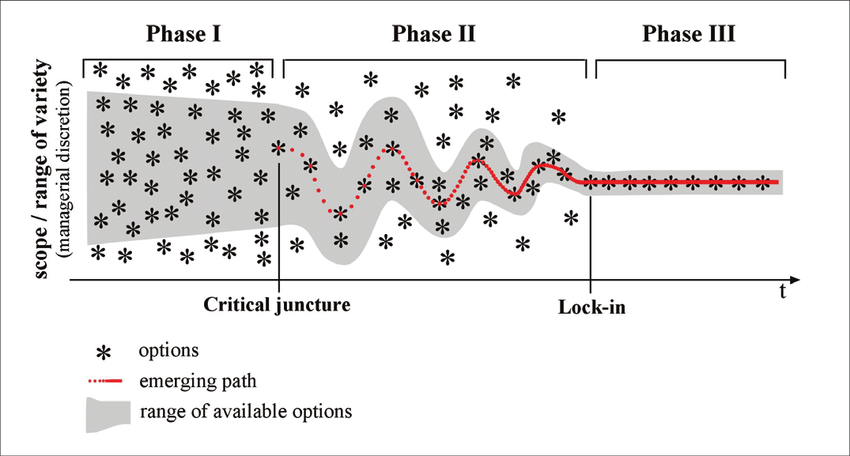
The graph presents the perspective of a “manager,” a governing entity. It can be a company manager, a chief executive officer, or a public-sector agent, such as a ministry’s planning office. Initially, in Phase I, the range of available options (grey area) is broad. As a result, there is significant managerial discretion. The manager has many options (*) to choose from. These options are available technologies that a company or the public sector can reasonably invest in. Options outside the grey area are so different from the technologies currently in use that investing in them would be unreasonable. It would make existing infrastructure useless and incur significant switching costs.
Imagine that, around 160 years ago, people were looking for a new technology to facilitate writing. One could come up with a few hypothetical options for achieving it. For example, constructing a floorboard with letters on it to jump from one to another, or a machine that transforms received voice into text. The former is evidently impractical, and the latter required technology unavailable at the end of the 19th century. For these obvious reasons, the economy focused on investing in technologies that enable people to type with their hands. It was a critical juncture leading to Phase II of the graph. The path (red) of further development gradually emerged, and the range of available options began to narrow. The further the industry specialised in searching for optimal solutions within this specific technology, the higher the number of alternative solutions not worth considering grew.
In the specific case of typewriting machines, Phase II was very short. It lasted only a few years. The first one, invented in 1868, had an alphabetical arrangement of keys. As early as 1873, inventors developed a more efficient design that would become the world’s standard. The economy became locked into a specific technological solution, and Phase III began, which continues to this day. Look at the keyboard in front of you. In Europe, as in China and almost everywhere around the world, these usually have a QWERTY layout.

It is a solution from the era of the first typewriters, which often jammed. The best way to avoid it was to separate on the keyboard the pairs of letters that most often appear next to each other in the English text. Even if someone scientifically proved that another layout, for example, the Dvorak keyboard, is more efficient (which is still controversial), it would be hard to replace it. We invested in the IT hardware industry, which is well-suited to producing QWERTY keyboards, and users grew accustomed to typing on them. Replacing them with a potentially more efficient layout would be costly and uncomfortable. As a result, we can be almost certain that Cixin typed Moonlight using the same keyboard layout I’m using to write this post.
In the Moonlight
The story begins during the Mid-Autumn festival. The protagonist looks out from his apartment at the city. Following the successful web petition, most landscape lighting and some streetlights were turned off that night so residents could enjoy the full moon. It makes him see, for the first time since he can remember, moonlight in the city. He observes that petitioners were wrong about the effect. The moonlit city is not the charming view they imagined. It resembles an abandoned ruin. But this brings a charm of its own. The view makes the protagonist reflect on “the passing of all and the discharge of all burdens.” The Moonlight is a short story, but Cixin succeeds in filling it with emotions and virtues – loneliness, regret, hope, empathy, selflessness, and bravery. It is impossible to express them in a post focused solely on its social dimension. Therefore, even if you decide to finish this post first, I still encourage you to reach for the story.
The protagonist holds a doctorate in Energy Planning. He is a staff member of the Planning Office of the Ministry of Energy. His responsibilities cover gathering information on the progress of new energy development projects across the country. At the moment, he is drafting a report that his supervisors will transfer to the minister, who will then present it to the State Council at their upcoming meeting. The report might determine which emerging energy technology will receive funding from the recent 4-trillion-yuan stimulus package, established in response to the economic crisis.
Suddenly, the protagonist receives a strange phone call from someone claiming to be his future self, calling from the year 2123. How is that even possible? According to the caller, in the 2030s, scientists will invent genetic therapies to extend human lifespan to around 200 years. However, he doesn’t explain the technology behind the “time phone call,” assuring the callee that it is highly complicated and that, either way, he has an order to share as little information as possible about the far future. Then why is he calling at all? Because Earth in 2123 is on the verge of an apocalypse. “The polar ice caps are gone. In the span of half a century, the sea rose by about twenty meters. Three hundred million coastal inhabitants had to move inland. Only desolation is left here, while the inland regions are gripped by political and social chaos. The economy is nearing total collapse.” They (or just he, depending on how you look at it) have a mission to prevent it. In the words of the caller: “Mere mortals doing what needed to be done a hundred years earlier would have the same effect as divine intervention now.”
How to save the world with a short phone call? Is it possible, even with an extraordinary one, which enables a person to contact himself from over 100 years ago? The caller takes a try. He is contacting to explain an advanced energy technology. Environmentally friendly, able to satisfy the 21st-century energy needs, and cheaper than fossil fuels. The competitive advantage of such technology is evident to the callee: “If you give us that, it won’t be ten years before the market will force all fossil fuels out of contention.” The technology is called the Silicon Plow. It “furrows in the earth just like a regular plow, but it extracts the silicon out of the soil and refines it into monocrystalline silicon. The land it processes turns into solar cells.” The protagonist receives an email, also sent by the caller from the 2123, with the technological details and a gloomy picture of the future of planet Earth, “an age without blue skies.” The sender knows his past self has the skills and position necessary to turn the tide of history by leading humanity down the path of sustainable energy enabled by the Silicon Plow.
The protagonist decides to dedicate his life to utilizing the priceless gift from the future. It is what this post is about: a new technology overcoming an incumbent one through the actions of an extraordinarily informed man, changing the fate of the whole planet. Therefore, let’s set aside the physical and philosophical discussions of the paradoxes of time travel. Because this is where things really start to get strange. Just 20 minutes after opening the email, the protagonist receives another phone call from his future self. The past phone call put the Earth’s economy on a different path. The year on the caller’s end is 2119. The call from the 2123 will never happen, even though they both remember it. Caller informs that “The first half of your-our-life has been a brilliant rising arc tied to the silicon plow, and in three years from your time, the technology will begin to spread across the globe.” Despite that, he is not contacting the past to send congratulations. Indeed, “In the 2020s, solar energy came to dominate world energy markets, and fossil fuels quickly vanished.” But “silicon plows transformed the face of every continent. After all the deserts had been turned into solar fields, they began to devour arable land and vegetation cover. Now, every continent is suffering from excessive siliconization.” The protagonist protests: “This should be impossible under theories of economics! As land grows more scarce, the value of any unplowed land ought to rise, and silicon plows should become too expensive to be viable in the market.” The answer from the future disappoints him: “This was no different from the history of the fossil fuel industries. By the time the conditions you describe came into play, it was too late. Shifting to alternative energy sources was no easy task, and even rebuilding the infrastructure for coal and oil required too much time.” The Earth’s economy got locked in. In 2119, silicon solar fields cover almost the entire planet, droughts sweep the globe, and the occasional rainfall triggers massive floods. Land siliconization appeared to be even more damaging to the environment than desertification.
The caller doesn’t contact the protagonist to congratulate him. But he does not call solely to mourn, nor. He has another energy technology to help the past Earth save its own future – ultra-deep drilling. Not getting into technical details, let’s say the technology is about to dig deep enough into the planet and be sufficiently heat-resistant to extract geoelectric energy from currents at depths of over 100 kilometres. It is about to be “the greenest technology. It doesn’t take up any land and doesn’t generate any carbon dioxide or other pollutants.” The protagonist receives an email with instructions on geoelectricity extraction. After deciding on initial steps in promoting the technology, he thinks: “l’ve decided on a new path. Has history changed again?” Yes, it did. Unfortunately, he learns about it from the third call, coming right after his thought. It comes from the year 2125. Protagonist has succeeded again: “Geoelectric power grew even faster than the silicon plow, and by 2020, the geoelectricity extraction industry had outgrown the coal and oil industries combined. As it matured, the efficiency and cost of this technology couldn’t be matched even by the silicon plow, let alone fossil fuels.” But at the beginning of the 22nd century, the source suddenly ran out, and with it the Earth’s electric field, which had once deflected the solar wind and protected the atmosphere. “The surface is full of radiation. You’ll die if you stay up there for a few hours without protection.” Bitterly disappointed with the outcome of all the interventions into the past, the caller asks the protagonist to delete both emails and let the Earth return to its “original timeline” of fossil fuel dominance. The story ends with the sentence: “The man who had changed the course of human history three times in a single night but who in the end had changed nothing fell asleep in front of his computer. Dawn brightened the eastern sky. The world began another ordinary day. Nothing had happened, at all.”
World Without Oil
Enjoying sci-fi literature is an exercise in imagination. That’s why the readers’ community recognises that alternate history books belong to this genre. Think about The Man in the High Castle by Philip K. Dick. It pictures the mid-twentieth century, after the Second World War, which the Allies lost. The technology there isn’t any more advanced than what’s available to us right now. There are no aliens or extraordinary environmental phenomena. And still, everyone recognises the book as a classic of the genre. The Moonlight prompts us to imagine the future without fossil fuels. Now, imagine the present without oil-powered vehicles. It may be more challenging. It’s more straightforward to imagine the extraordinary far future than a significantly modified present. How could a 21st century without oil-based vehicles even happen? Let’s consider dark and bright scenarios. In the dark scenario, we suddenly exhaust all of the global oil reserves. Most of our transport system falls. The long-distance trade system no longer works. Most people have no choice but to limit their consumption to goods within their much shorter reach. All this leads to political tensions of potentially fatal consequences.
The bright scenario is an exercise in alternate history. The narrative I’m about to present here doesn’t come from a sci-fi prose but from one of the best books in my research area — Michael Roos’ Principles of Complexity Economics. The vast majority of modern cars use internal combustion engines, which run on gasoline or diesel. Both are types of oil. The first commercially successful engine of this kind was an 1860 invention by the Belgian-French engineer Etienne Lenoir. Early machines like this one could be powered by either oil-based fuels or alcohol, e.g., ethanol. As early as 1905, there was a debate in the USA over the benefits of using the latter rather than the former to drive automobiles. Ethanol was already recognised as a renewable, clean, safe, and better-smelling alternative to gasoline derived from oil. According to historian Tom McCarthy, “By 1906, alcohol had become the preferred alternative to gasoline. There were pros and cons to both fuels, but there was no great debate or controversy among the experts about the best alternative” [e]. In the early twentieth century, ethanol had several advantages over gasoline as an energy source. Also, oil exploitation results in high carbon dioxide emissions. Svante Arrhenius, a Swedish chemist, predicted the relationship between them and global warming as early as 1896. What could have gone wrong?
We have a somewhat cynical saying in Poland: “If you have no idea what something is about, then it is about the money.” It is right in this case. The production costs of ethanol were twice those of gasoline. So the latter already had a significant competitive advantage in the market for technologies. Here entered the law. It is a good example of how the unintended consequences of legislation aimed at regulating a specific issue can determine the path of technologies not considered in the law-making process. In the early 1900s, the USA imposed new taxes on alcohol to discourage drinking. It raised the price of ethanol to about 10 times the price of gasoline. The leniency of early antitrust law in the US was another issue. The giant Standard Oil conglomerate easily dominated the market by building an extensive distribution network before fuel alcohol was widely available. But engineers could solve these problems soon with appropriate R&D and investment. A single well-informed phone call back from our times to the early 1900s could create a world with cars powered by renewable energy – a world with much less carbon dioxide, a healthier population, and maybe even global warming kept under control.
Afterthoughts
Since 2015, when reading became my main activity, I had stuck to classics. I had my reasons. I was 18 years old and had secured a place at the university in the penultimate year of high school through a national social studies contest. I decided to spend the spare year studying the history of philosophy. But I had another motivation. I wanted to understand time-tested works that shaped humanity’s cultural heritage. I wanted to learn a language of ideas and emotions shared by all people. After a decade of reading solely classic literature, I kept discovering old hidden pearls of philosophical fiction, but started feeling limited by the possibilities left to me in this area. At the end of 2024, I decided to switch to science fiction. Just like the 10 years before, I have a few reasons for making the choice. I expected that in this genre, it would be much easier to find brain food for my research on complexity economics, digital markets, and legal informatics. Also, I wanted to better understand some of my best friends who spent a lot of time reading critically acclaimed sci-fi novels. Following their type, I reached for The Three-Body Problem in early 2025. That’s how one of the most exciting intellectual adventures in my life began. A year later, I must agree with a statement by the unnamed Time Magazine reviewer I found on a back cover of Neal Stephenson’s Anathem: “Whatever happened to the great novel of ideas? It has morphed into science fiction.” Sci-fi literature is full of well-thought-out insights into all social problems, and everyone can find something for themselves to learn. If you’re into technology, innovation, economics, and law, Cixin Liu is a perfect match for you. And it has additional value for us, non-Chinese, introducing ideas on the most recent history and contemporary culture of this great country.
To conclude, I’d like to share with you what, in my opinion, is the most important lesson to learn from Moonlight. The story tells that even the most sustainable energy sources can lead to an environmental catastrophe when overexploited. It leaves the reader with a question: Is progress in technology and welfare enough to prevent tragedies caused by human greed and ruthlessness? The question is ancient and, in fact, the very main topic of the over 2,100-year-old Debates on Salt and Iron mentioned at the beginning of this post. We hope to provide you with more reflections on this age-old text in the article we’re working on with Lyuxing. Moonlight shows that saving the Earth is not a matter of technology or economics but instead of culture and ethics. The future path of the Earth depends on our everyday small choices. On how we travel, what we eat, and where we buy. Of course, it is a sum of choices made by all of us that makes the real impact on the world. One cannot save the world alone, even with guidance coming from the future 100 years ahead. But it’s not a reason enough to think of others’ wrongdoings as an excuse. It’s a reason to make yourself an example for others to follow for the common good. Especially the good of those ahead of us, to whom we owe the Earth. On a more personal note, 2026 will be the seventh year I’ve been vegan, with no single exception so far, and I do not expect any to come on my own will. The choice I made long ago, for ethical, political, and environmental reasons, has led to path dependence. But I never pushed anyone to join me on this challenging path. It’s because the future of the Earth doesn’t depend on some more of us becoming radicals like me. It depends on all of us becoming a bit more moderate in our consumption and conscious of the long-term global consequences of our choices.
Notes
[a] By these I mean, among others, Mo Yan, Yun Hua, and Gao Xingjian.
[b] For another excellent story about early Chinese emperors experimenting with computers, check Cixin’s Circle.
[c] I’ll do nothing more but a brief remark, to avoid any spoilers, that one of my favourite plots in Dark Forest is also a story of ‘path dependence’ and radical ways to make use of it. My fellow fans will probably know what I mean.
[d] W.B. Arthur, Competing Technologies, Increasing Returns, and Lock-In by Historical Events, The Economic Journal, Vol. 99, No. 394 (Mar., 1989), pp. 116-131.
[e] T. McCarthy, The coming wonder?: foresight and early concerns about the automobile, Environmental History, Vol. 6, No. 1 (Jan., 2001), pp. 46-74.


Leave a Reply