CLEP – The interconnected challenges of the 21st-century global economy necessitate a reevaluation of competition law systems worldwide in the spirit of multidisciplinarity. It means not only reviewing in light of its intellectual roots in jurisprudence, microeconomics, and ethics, but also recognizing the rapidly increasing number of valuable insights from contemporary studies on information and complexity. This blog post marks the beginning of the Competition Law, Economics, and Philosophy series, which will comment on this process. It will be a mix of these three disciplines, seasoned with a bit of literature, science, technology, and personal experience.
Useful knowledge for competition lawyers
from the complexity economics of Joel Mokyr
The picture I have formed of the terrible simplifiers who are going to descend upon poor old Europe is not an agreeable one. […] Sometimes I meditate prophetically on how our learning and quisquilian researches will fare when these events are in their very early stages, and culture, in the interval, has only sunk a peg or two.
Jacob Burckhardt, historian (1889)
File: SSRN
Award for “terrible simplifiers”
In 1968, on the occasion of its 300th anniversary, Sveriges Riksbank, the world’s oldest central bank, established the Prize in Economic Sciences in Memory of Alfred Nobel. Despite its absence in the last will of the famous Swedish inventor and philanthropist, the award shares many characteristics with the original Nobel Prizes in five disciplines. Recipients accept it at a single ceremony; the prize amount is equal, and, as with distinctions in physics, chemistry, or medicine, it is awarded by the Royal Swedish Academy of Sciences, according to the same principles since 1901. All this leads to calling it simply ‘Nobel Prize in Economics‘ and often causes controversy, mainly over respect for the founder’s last will or the scientific status of economics. I share some of these concerns and therefore feel obliged to open the post with this intro, as I’m also going to use this misleading name solely for its readability.
In some years, the Nobel Prize in Economics becomes particularly controversial due to its new recipients. Sometimes these controversies result from the radical character of the economic theories they develop and spread. More often, the reason is views expressed by awarded economists proving their ignorance or even hostility to the scientific and humanistic achievements of other disciplines. Many recognize awarding the 2018 prize to William Nordhaus for his Dynamic Integrated Climate-Economy model (DICE) as an example of such a blunder. Above all, his discounting methodology, which calculates the present value of future costs and benefits, was highly controversial from the perspective of moral and political philosophy. Moreover, the model’s assumptions must seem ridiculous even to a layperson. One of the most contentious economists living, Steve Keen, commented that his mainstream fellowmen modeling climate change made a terrible mistake by “using three spurious methods: assuming that about 90% of GDP will be unaffected by climate change, because it happens indoors; using the relationship between temperature and GDP today as a proxy for the impact of global warming over time; and using surveys that diluted extreme warnings from scientists with optimistic expectations from economists.” Speaking specifically about Nordhaus, he adds “damages from climate change are at least an order of magnitude worse than forecast by economists, and may be so great as to threaten the survival of human civilization.” Many other critics expressed their doubts, which I can briefly summarize in technical terms. Nicholas Stern argued that DICE’s damage function does not capture many of the risks crucial to society. Martin Weitzman pointed out that “Fat-Tailed Uncertainty in the Economics of Catastrophic Climate Change” can easily lead to an inadequate response to low-probability, high-consequence outcomes. Christopher Ketcham criticized Nordhaus’ methods and assumptions, which failed to recognize or value tipping points in environmental threats. The best summary came from Robert Pindyck, who explained that integrated assessment models like DICE cannot capture the complexity of the climate-economy nexus [a]. And the ongoing climate change might become an ultimate (sic!) proof that our planet is a complex adaptive system (CAS).
Warning for “old Europe”
Traditionally, the Nobel Committee has rejected interpreting its Prize in Economics choices as any form of social commentary. Its decisions are supposed to remain isolated from ongoing political discussions and to choose a candidate with the most “outstanding contributions to mankind in the field of Economic Sciences.” I don’t think it is possible to use such a criterion without stepping into politics. The question of what “contributes to mankind” is deeply political. It is even more like that right now for two reasons. The first is the global geopolitical environment with destabilized links of trust between plural powers. The post-Cold War international order gave rise to a rivalry between powerful superstates, distinguished to a large degree by diverse models and histories of economic development. The old Europe keeps its place among these superstates thanks to its new form of the European Union. This small but complex continent comprises dozens of countries that often differ significantly in culture and national interests. Many of them have a centuries-long history of balancing market competition with state intervention. These days, they look for consensus, enabling them to face the challenge of a new kind of economic rivalry. The rise of mass media giants from the United States of America and the People’s Republic of China forces Europe to reevaluate its essential institutions. As diverse as free speech and diplomatic protocol. Recent developments in this domain, especially those related to generative AI, are intensifying debates over the balance between innovation in the European Union economy and various forms of social safety.
The second reason is the character of the leading economic research in the 21st century. Keywords in the Nobel Prize rationale over the last few years have been poverty, institutions, and innovation. Not the traditional categories like money, output, growth, allocation, and, most of all, equilibrium, which used to dominate choices in the past century. This change might be among the factors that sparked greater public interest in this specific Prize. Some laureates, such as behavioral economists, seek to answer questions about individual choices that, by their nature, are well-known and accessible to all humans. The Nobel Prize in Economics has become a part of pop culture. It decides whose name will shine on the bookstores’ exhibition in the coming months and what face we’ll see more often on TV or social media [b]. The 2024 award has proven how short the distance is between leading economic research and public debate. The winners – Acemoglu, Johnson, and Robinson – were already, at the moment, not only oft-cited scholars but also authors of three bestselling books: Power and Progress (A&J, 2023), Narrow Corridor (A&R, 2019), and especially well-received Why Nations Fail (A&R, 2012). As one might guess from the title of the last one, it contains many warnings for contemporary countries, both at the bottom and at the top of the global GDP ranking [c]. The focus on the need to defend social and democratic institutions, the popularity of the books, and the progressive agenda of the three laureates, among whom Acemoglu openly and regularly criticizes Trump’s policies, made the 2024 Nobel Committee’s choice well-received in many political circles. Their ongoing research on the changing role of economic power in the digital economy has only increased interest in the domain of competition law and policy.
Win by Acemoglu, Johnson, and Robinson caused appraisal in many progressive and liberal (or however they call these where they come from) circles around the world. But I cannot help but notice that the 2025 Nobel Prize awarded to Aghion and Howitt sparked even greater enthusiasm, visible especially among competition lawyers and economists. The concept of ‘institutions’ is appealing these days, when so many liberal democracies face constitutional crises. However, it might also raise reasonable skepticism among those who look for the causes of this legal issue, as well as the ongoing economic trouble, in flaws of some dominant public institutions (the state itself among them). On the other hand, the concept of ‘innovation‘ appeals to almost everyone these days. Competition lawyers and economists who don’t prioritize innovativeness and dynamism are a dying breed. Of course, while favoring innovation, they define and evaluate it in many different ways. Still, this diversity is not an obstacle to any of them welcoming the Prize awarded to the creators of the Aghion-Howitt model. Implications of this analysis framework can support policy arguments across the political spectrum. The “economic-right-leaning” commentators can focus on the ‘creative destruction’ implications, arguing that innovation results from the pursuit of profits, market power, and monopolistic ‘rents.’ It suggests that competition law should be lenient toward these practices. The “economic-left-leaning” authors can underline the implications concerning the harsh fate of inventors – underinvestment, spillovers, and lack of capital necessary to compete with well-established products. Based on that, one might opt for a law recognizing the greater need for small-business protection in the field of innovation.
Time for “our learning”
Alden Abbot is right to observe that all 2025 Nobel Prize in Economics laureates interpret the economy as a dynamic system. Competition lawyers and economists should acknowledge that “The trio’s research, which explains how innovation drives economic growth through a process of ‘creative destruction,’ challenges the traditional, static view of competition.” However, compared to Aghion and Howitt, historian Joel Mokyr received much less attention in the comments on the 2025 Nobel Prize coming from the competition law and economics community. In some of them, his presence was limited to a remark that he works on similar issues from a long-term perspective, and that the implications of his work align with research on innovation done by the other two laureates. Even putting aside the fact that Mokyr got half of the Prize, twice as much as Aghion or Howitt, who share the other half, it still seems unfair. What might be the reason behind this injustice? Does economic history raise less interest than economic modeling? Maybe the explanation lies in the alignment mentioned above. Maybe competition lawyers who see two equally distinguished research projects with a similar topic and conclusions, for pragmatic reasons, show more interest in clear insights of the modern economic model and treat historical study as a lengthy appendix. These questions gave me the motivation to write a short post addressed to competition lawyers, focused on Mokyr, and explaining the unobvious character of his research.
Some may consider awarding the Nobel Prize in Economics to Mokyr to be the exceptional distinction this subdiscipline, economic history, has received so far. There are many good reasons to disagree with such a statement. As an author of a few published papers on the modern history of economic thought, I consider myself to belong to Mokyr’s tribe. I have a special sympathy for his research because he is one of the few distinguished scholars who combine the history of the economy with the history of economic ideas in their study. And that’s an approach I try to pursue myself. Still, at this point, I’m obliged to put tribal solidarity over personal sympathy and observe that the Nobel Prize Committee has previously, especially in the last few years, awarded prizes for various economic studies of history. An obvious example comes from three decades ago, when in 1993 the Prize went to Robert W. Fogel and Douglass C. North “for having renewed research in economic history by applying economic theory and quantitative methods in order to explain economic and institutional change.” But a closer look at the 2020s might lead some to a surprising conclusion that the Nobels markedly favour economic history. In 2022, Ben S. Bernanke, Douglas W. Diamond, and Philip H. Dybvig received the Prize for their analysis of the Great Depression of the 1930s. In 2023, Claudia Goldin won for spending her life building up and rigorously analysing decades of data on women’s labour. A year before, she stated: “I am first and foremost an economic historian.” Moreover, the long-term perspective on the history of institutions and economic progress is the essence of research done by the 2024 Laureates mentioned above, Acemoglu, Johnson, and Robinson.
His historical perspective alone is not a reason for me to write a post on Mokyr addressed to competition lawyers. It is neither the kind of history he writes about. His famous books are informative and rewarding, but they are long and require patience. An attempt to quickly Ctrl+F them for the term ‘competition’ reveals that, while studying innovations, he writes much more about rivalry between states than between companies. One can also encounter a segment on the economic competition between Christian religious orders. It might initially surprise a reader looking in Mokyr’s books for studies on the history of markets. Still, the author quickly explains how conflicts among monks accelerated innovation in the medieval European education system (Culture of Growth, 2017, p. 130). His research spends little time on mid-size actors, such as local guilds or early companies, and instead focuses on direct links between continental politics and innovative individuals. Meanwhile, the role of specific personas in the competitive process and their impact on innovation is rarely discussed in competition law and economics literature. In summary, the current importance of Mokyr’s research for our discipline lies not in the way he does history, but in his understanding of it. Mokyr argues that history exists. The history is relevant. Understanding the consequences of this seemingly obvious statement makes one realize what the existence of history tells us about the nature of reality. The reality as it is now and ever will be (as far as we can think of it).
Hope for “quisquilian researches”
The quote opening this post comes from a 1889 letter written in French. I had to look up the meaning of this now-obsolete adjective ‘quisquilian.’ This word describes something relating to or consisting of rubbish, trash, or refuse (deriving from the Latin phrase quisquiliae for ‘sweepings’). The sender, Jacob Burckhardt, used it ironically to express his pessimistic prognosis on the near future of the new subdiscipline he developed, the history of art [d]. Academia doesn’t know stability. There are always some new or forgotten perspectives and objects fighting for their recognition. Some of these new subdisciplines don’t succeed and remain obscure. Others, often thanks to enduring individuals, strive for decades and gradually influence mainstream research. Almost a century after the letter was written, the late 1970s in California saw an avant-garde economist who believed that instability characterizes not only academic programs. W. Brian Arthur stated that instability is inherent to the world we live in, and that economics should reflect it rather than using complete equilibrium, perfect competition, and stable markets as reference points. Above all, he said, economics needs to abandon the assumption of diminishing returns to scale. Long before a subdiscipline he started got the name ‘complexity economics,’ Arthur called himself an economist studying “increasing returns.” As one might imagine, such a radical overturn required an intense, long-term effort to achieve recognition.
Arthur kept asking himself questions. Why had high-tech companies scrambled to locate in the Silicon Valley area around Stanford instead of in Ann Arbor or Berkeley? Why did the VHS video system run away with the market, even though Beta was technically a little bit better? Then he came up with answers. Because many older high-tech companies were already in Silicon Valley. Because a few more people happened to buy VHS systems early on, which led to more VHS movies in the video stores, which led to still more people buying VHS players. Based on these questions and answers, he sketched a “new” approach, now known as complexity economics.
On November 5, 1979, he poured it all out. At the top of one page of his notebook he wrote the words “Economics Old and New,” and under them listed two columns:
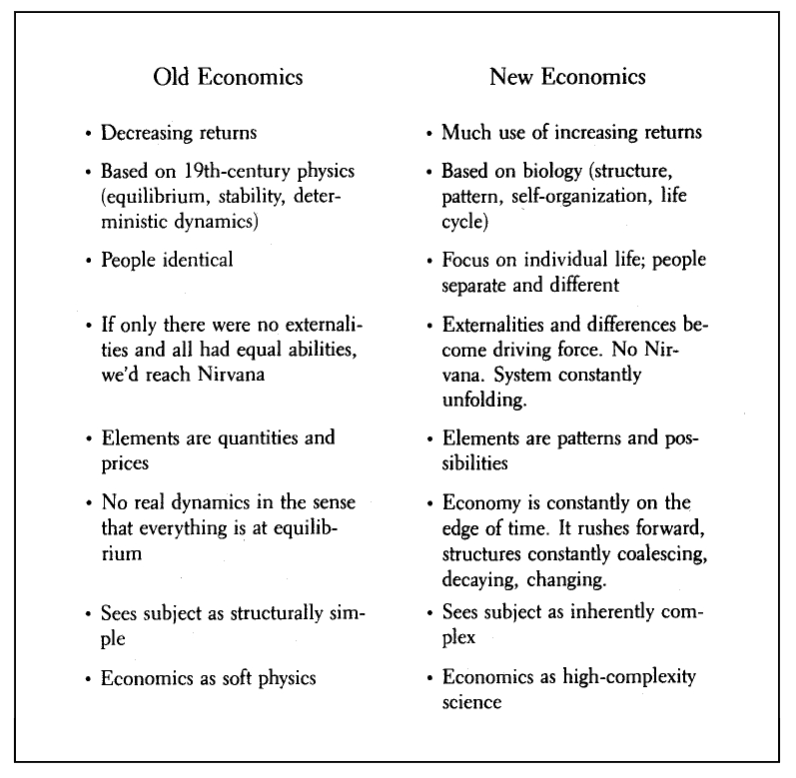
(source: Mitchell, 1993, pp. 37-38)
In 1983, this sketch turned into Arthur’s first paper on increasing returns. The official, published version wasn’t to see the light of day for another six years. The most prestigious U.S. journal, the American Economic Review, returned the paper in early 1984 with a letter from the editor stating that the submission didn’t make sense. The Quarterly Journal of Economics sent the paper back, saying that its reviewers found no technical faults but didn’t think the work was worth anything. The American Economic Review, under a new editor this time, accepted the paper on its second submission, kept it internally for 2.5 years, and demanded numerous rewrites, only to reject it again. Arthur had to look for a publisher abroad. The Economic Journal in Britain initially also rejected his submission. However, after some fourteen rewrites, the paper was finally accepted there and published in March 1989 as ‘Competing Technologies, Increasing Returns, and Lock-In by Historical Events.’
Arthur found all his 1980s rejections double-frustrating when he realized that, while he was stuck in editorial limbo, the idea of increasing returns was finally beginning to catch on. This process started to a large degree thanks to contemporary research in economic history. In Arthur’s day, Stanford University had a first-rate group of economic historians – the people who conducted empirical studies of the history of technology and the origins of industries. For years, they had suffered from the fact that the ‘old’ economics, “if really taken seriously, says that history is irrelevant. An economy in perfect equilibrium exists outside of history; the marketplace will converge to the best of all possible worlds, no matter what historical accidents intervene” (Mitchell, 1993, p. 50). In other words, contemporary economics departments behaved as if ‘history doesn’t exist’ and considered scrapping their required courses in economic history. Some economic historians saw Arthur’s arguments on increasing returns as providing them with a rationale for their existence. They liked the idea that small events could have significant consequences. Historians embraced the concept of economics as a “high-complexity science” (see table above).
Mokyr is, without a doubt, a continuer of the increasing-returns approach to history and one of its brightest and most prolific minds. It aligns his research with Arthur’s “new” economics, now known as complexity economics. Just like the latter, Mokyr established “an often-neglected field of inquiry as a vibrant mainstay of academic life” (Besimi, 2025). Economic history’s alliance with complexity economics is natural, given that history is complex. It’s made of evolution, patterns, path dependence, processes, and feedback loops. History does not know equilibrium. Studies on changing technology serve as an example here. Mokyr directly suggests considering multi-level competition, not only between companies but also between distinct technologies, and grounding this understanding in insights from the exact sciences studying the evolution of complex adaptive systems: “The competitive game here is played not at the level of the firm but at the level of the techniques themselves. Winning this game means that a technique or a cultural trait is what evolutionary biologists call “adaptive.”” (The Lever of Riches, 1990, p. 276).
Taking all of the above into account, I have no choice but to disagree with Mark Sanders, who, for some reason, stated that “both Mokyr and Aghion and Howitt emphasize in their work the process of competition and selection that follow, but spend little time on the origins of new ideas. […] More evolutionarily inspired economists like Richard Nelson and Sid Winter or our own Bart Verspagen and Luc Soete, would probably point out that innovation can never be a predictable routine and there is no recipe for growth.” In 1998, Mokyr even published a paper titled “Induced technical innovation and medical history: an evolutionary approach.” Also, already in the title of another article, he presents “Useful Knowledge as an Evolving System.” Mokyr later, in 2002, gave a presentation on this research at the very same Santa Fe Institute where Brian Arthur expounded his ‘new’ perspective, in the headquarters of complexity economics. In the following paragraphs, I will discuss the concept of ‘useful knowledge’ and its importance for contemporary discussions on competition law and economics.
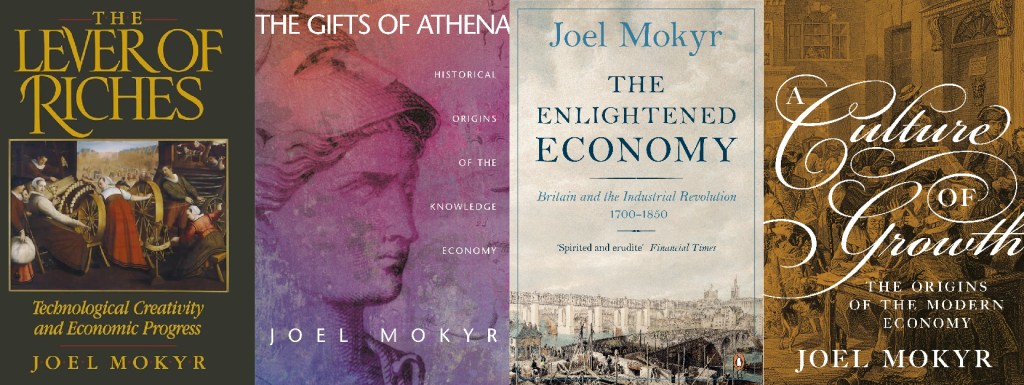
‘Useful knowledge‘ is one of the most important concepts in Mokyr’s entire body of work. While discussing it, he broadly comments on the positive feedback loop (PFL) it generates, an effect that is so characteristic of the perspective of complexity economics. The following paragraphs were, to a significant degree, based on a few insightful texts, which I will, from now on, quote prominently. These were authored by Alden Abbott, Fatmir Besimi, Kevin A. Bryan, Ran Abramitzky, and Mauricio Drelichman. In his books and articles, Mokyr traces the historical symbiosis of propositional (theoretical & scientific – why?) and prescriptive (practical & applicable – how?) knowledge, which synergizes into the engine of a self-reinforcing growth trajectory, a positive feedback loop. Bryan comes up with handy definitions of these. Propositional knowledge is “a systematic description of regularities in the natural world that demonstrate why something works.” Prescriptive knowledge is made of “practical instructions, drawings, or recipes that describe what is necessary for something to work.” One should recognize Aurelien Portuese for applying Mokyr’s theory to competition law research as early as 2024. However, in his text, he wrongly juxtaposes propositional and useful knowledge, whereas, according to Mokyr, the latter is a sum of the former and prescriptive knowledge.
In Bryan’s view, “Mokyr shows that, prior to the Industrial Revolution, technological innovation was primarily based on prescriptive knowledge. People knew that something worked, but not why.” On the other hand, “Propositional knowledge, such as in mathematics and natural philosophy, was developed without reference to prescriptive knowledge.” This led to both the squandering of opportunities created by new discoveries and of resources on those doomed to failure. In the words of Besimi: “Before the Industrial Revolution, technical experiments often failed to translate into scalable change precisely because underlying scientific understanding was weak or not systematically connected to practice.” Many of the brightest minds spend their lives on futile endeavors (wondering how to achieve certain goals without knowing why they are unreachable), such as the construction of a perpetual motion machine or the pursuit of alchemy to produce gold. Mokyr explains how the Enlightenment and accompanying institutional openness gradually broke the barrier between propositional and prescriptive knowledge. It formed a positive feedback loop between science and application, scaling the production of useful knowledge. The Enlightenment, with its Scientific Revolution, preceded the Industrial Revolution.
There is no strict consensus on the time framework of the so-called Enlightenment. It spanned the whole “long 18th century” (in other words, from the late 17th to the early 19th). Its essential part was the process now known as the Scientific Revolution. In these days, “Scientists began to insist upon precise measurement methods, controlled experiments, and that results should be reproducible, leading to improved feedback between propositional and prescriptive knowledge. This increased the accumulation of useful knowledge that could be utilised in the production of goods and services” (Enflo and Hassler, 2025). A poster invention of the Industrial Revolution, the steam engine was improved by insights into atmospheric pressure and vacuums, along with advancements in steel production, enabled by understanding the chemical interaction between oxygen and carbon. Emergent gains in useful knowledge not only facilitated technological improvement but also opened new areas of use. The writings of various scholars, especially those of the Scottish Enlightenment – David Hume, Adam Smith, Dugald Stewart, and Francis Hutcheson – were the true engine behind the Industrial Revolution. They “instilled the ideas that nature could be known and mastered, and that its laws could be elucidated through scientific research”. At the same time, “the proliferation of learned societies, periodicals, and informal intellectual networks fostered the spread of practical knowledge” (Abramitzky and Drelichman, 2025). The Scientific Revolution transformed not only the technology and economy but also the basis of human reasoning. Bryan intelligently observes that “It is hard for us today to understand how revolutionary ideas like ‘experimentation’ or ‘probability’ were.”
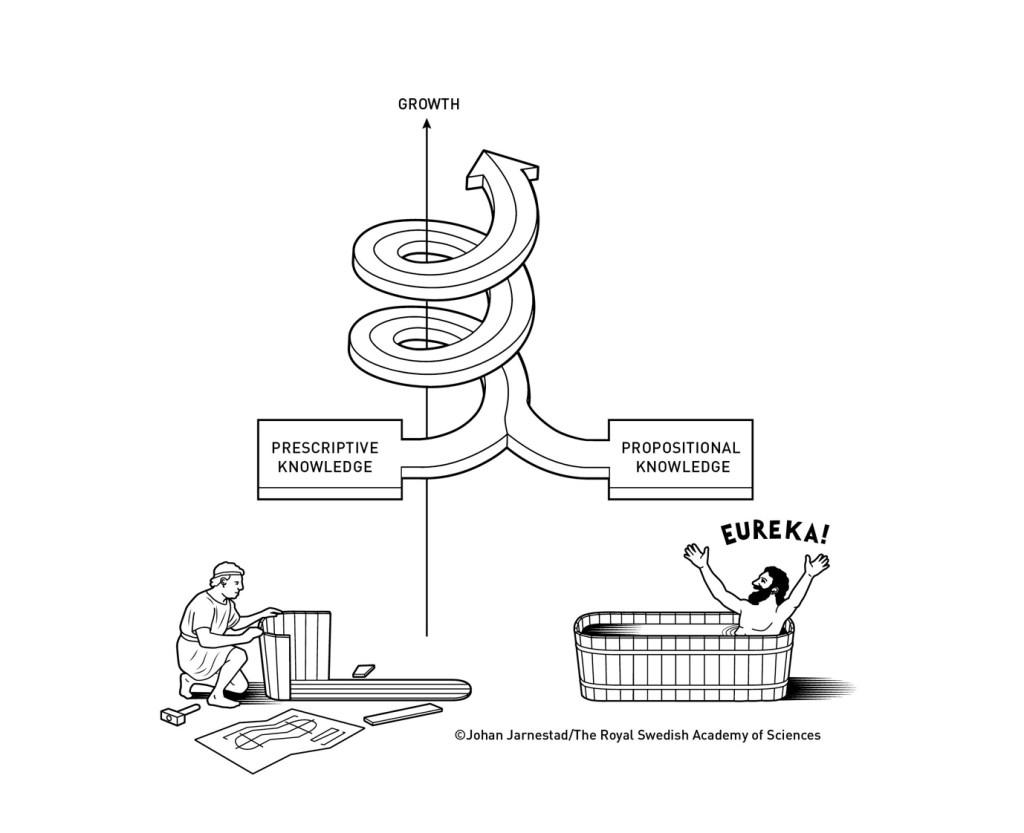
“Economic growth first took off when there was a connection between prescriptive and propositional knowledge. However, sustained growth also requires practical, technical and commercial knowledge, as well as a society that is open to change.”
As I already mentioned before, ‘feedback loop’ is one of the fundamental concepts of the science of complex adaptive systems and, therefore, of complexity economics. Petit and Schrepel explained its fundamental importance for the enforcement of competition law in the 21st century in their 2023 article. Mokyr shows how economic growth first took off when and where there was a connection between prescriptive and propositional knowledge, creating a positive feedback loop between them. However, sustained growth relies not only on scientific, technical, or commercial knowledge, but also on a society open to change. Most of the inventions that powered the take-off of the Industrial Revolution came to Great Britain from continental Europe. Isles didn’t overtake the rest of the world due to a first-mover’s advantage, but rather because of its political framework, which, as observed by Abramitzky and Drelichman, “provided security and openness: relatively tolerant of dissenting views, less censorious than continental regimes, and supportive of patent law and infrastructure.” Also, “many of the advances in mathematics, chemistry and physics that would later be applied to industrial machines originated in France, Germany and beyond. Importantly, however, it was in Britain’s cultural and institutional environment that those ideas coalesced into a veritable engine of growth.”
The road to progress and wealth leads through reinforcing positive feedback loops between propositional and prescriptive knowledge. It means accumulating the Mokyrian useful knowledge. This close interaction makes the innovation process cumulative and self-sustaining. The rise of computing power and advanced AI creates new opportunities in this area. Besimi observes that “AI, with its capacity to accelerate scientific discovery, automate translation of theory into prototypes and generate new insights, may strengthen this feedback loop. We may be entering a phase where the pace of useful knowledge accumulation accelerates in non-linear ways.” As a researcher in competition law, following discussions on the future of this discipline, I’m especially interested in the same kind of positive feedback loop one can observe between complexity economics (propositional knowledge) and computational methods (prescriptive knowledge) in this area. These two reciprocally feed each other with insights. Complexity economics employs computational methods to better understand the evolution and emergence that constantly occur within the complex system of the economy. However, these are still hard to explain with standard tools like econometrics. Creators looking to improve their computational systems observe ubiquitous complex systems in search of understanding their robustness, resilience, endurance, optimization, and adaptability. Computational systems aim to learn from complex systems to acquire their characteristic features. These real-world qualities enable artificial systems to excel in computation. E.g., adaptability, so characteristic of living organisms, is the foundation of machine learning.
I think the future success of competition law, by leveraging the feedback loop between the theory of complexity economics and the practice of computational methods, will depend on acknowledging Mokyr’s insights (my paper coming). The best way to do it is by following two recommendations articulated by Besimi in his text on the Nobel Prize recipient. First, “Policymakers and technologists should not operate in separate silos. Technological foresight without institutional design is brittle; institutional rules without technical literacy may be blind. Cross-disciplinary collaboration is essential.” Second, “academics and universities should renew their commitment to bridging the ‘two cultures’ of science and application. That bridging is precisely what Mokyr calls for and what today’s challenges demand.” The third one, coming from Abbott, says that “governments can actively promote a climate of innovation through various policies. These may include, for example, funding basic research, ensuring a robust and well-funded higher education system, and fostering a society that is open to change and new ideas.”
Remedy for “these events”
Swiss historian Jacob Burckhardt, whose life spanned the 19th century, saw the end of his days in 1897, in the midst of the so-called “second industrial revolution.” Just a year after he wrote a letter fragment that opened this post, the US Congress passed the Sherman Act in response to ongoing technological changes in the North American economy. We’re also living through another technological shift. Some experts call it the fourth, some the fifth, but most agree that the 21st century brings an industrial revolution of a new kind. Burckhardt coined the term ‘the terrible simplifiers’ to express his dark vision of the coming industrialized 20th century, dominated by demagogues and brutes (Dru, 1955, p. 220). His colleague at the University of Basel, Friedrich Nietzsche, shared his pessimism and described these anticipated leaders as power-maniacs (Gewaltmenschen). History violently amplified their predictions. Weak institutions in the declining European empires sparked the conflagration that became the First World War. The following Great Crisis left thousands of industrial workers unemployed and resentful. The Second World War made every use of novel technologies to slaughter and destroy on an unprecedented scale [e]. While keeping all these tragedies in mind, this final section speculates on the “New Enlightenment” we might need to support ongoing technological and institutional changes and overcome some of their unfavorable outcomes.
The “great simplifiers” of early 20th-century Europe appealed to those who recognized themselves as victims of recent history. Not only veterans of the lost wars, but also crowds dispossessed by rapid technological changes. Weak political and social institutions in this era did not care for these people and left them to fall into a trap of populist radicalism. It is no coincidence that these days, we also observe, among others, both rising technological unemployment and support for far-right parties across the continent. Fiona Scott Morton has shown a deep understanding of the comprehensive economic policy when commenting on the 2025 Nobel Prizes in Economics: “Fundamental values require governments to look after those workers who are harmed by the process of creative destruction”, and “protecting the people themselves through support and training, equipping them to find work in growing sectors.” The workers who lose their jobs in this process are not guilty. Exactly the opposite, they are doing a challenging job by internalizing the costs of economic growth. Whilst reinforcing the feedback loops, we should not forget the various limits and externalities that threaten their sustainability. Supposed economic growth doesn’t guarantee benevolent outcomes. Many ongoing technological changes in the digital economy are driving environmental degradation, job polarization, the concentration of market power, and threats to liberal democracy. In his work, Mokyr cautions against the need to correct unintended consequences through appropriate public policies. It’s worth reflecting on the “fundamental values” Morton mentioned.

”New innovations build upon, and take over from, previous innovations due to creative destruction. This process creates economic growth and, over time, has fundamentally changed society.”
Mokyr’s work explains how Great Britain emerged as an economic power during the Industrial Revolution, not through first-mover advantage, but through a culture of growth that fostered ethical and political values supporting progress. These values were, first of all, institutional openness and intellectual freedom. Societies that respect dissent, accept new ideas, and protect them from capture by entrenched interests are the ones that support economic growth. Abramitzky and Drelichman shortly summarize Mokyr’s intellectual heritage, “one core message of this extensive body of research is particularly timely: economic progress is critically dependent on open intellectual inquiry, on the free exchange of ideas, and on a vigorous defence of scientific principles.” Besimi concludes directly, “Economic progress is critically dependent on open intellectual inquiry, on the free exchange of ideas and on a vigorous defence of scientific principles. Coming at a time when such principles are increasingly under attack, the Nobel Prize reminds us that curiosity, pluralism and intellectual cooperation are what created wealthy societies, and that retreating from them puts at risk all the benefits of sustained growth.”
Values matter for the economy. And there is no value-free economics. The example of a Nobel Prize awarded to Nordhaus discussed in the first section of this post shows that there is politics even behind mathematics. We should not abandon values inherent in our culture in pursuit of myopic economic growth, nor succumb to those who accuse normative considerations of losing sight of “objective economic arguments.” Please let me quote Besimi’s comment on Mokyr’s win for one last time: “The timing of this award is particularly salient given the rise of artificial intelligence, generative models, and transformative digital technologies,” and its recipient teaches us that “sustained, inclusive growth is neither automatic nor frictionless and in an age of accelerating technological change, we must rethink policy, social contracts, and institutional design.” This reflection might be put into practice, simply, in the context of AI technology, at both the individual and public policy levels, by favoring common benefit over exploitative business models. Two great books I have recently had the pleasure of reviewing, Roos’ Principles of Complexity Economics and Ziccardi’s Legal Informatics, offer advice in this area addressed to competition lawyers and economists.
For the numerous reasons touched upon in this interdisciplinary post, I claim that the Nobel Prize awarded to Joel Mokyr is also a success of complexity economics, a sign of the times, and a harbinger of change. This perspective might have had more legitimate recipients of this award before – Simon and Hayek – but it’s still waiting for one generally recognized as its representative. The coming years will show whether any of the complexity economics founders, such as Arthur or Farmer, will receive this honour. Meanwhile, we should embrace Mokyr’s victory and learn from him. Complexity economics doesn’t like laws. It rather looks for patterns than truths. However, Mokyr’s lesson from economic history is general enough to serve as a potentially universal recipe for sustained economic growth. Continuous progress requires a constant flow of useful knowledge. A stable dialogue between inquiry into why things work and research on what is required to make it work.
We cannot escape history. And not only history matters. Values matter just as well. The past industrial revolutions teach us that ignoring them is not only despicable but also counterproductive. Our wealth is based on our values, and we should be ready to spend it on protecting them. The ongoing technological shift warns that this might require a “New Enlightenment.” Some examples of competition law literature offering original philosophical perspectives on these issues are already available. I recommend checking on a recent article by Jorge Padilla introducing the idea of hopeful pessimism, or the text by Stavros and me on the theory of complex democracy. What do weak institutions, lack of innovation, and ignorance of history have in common? They all fuel reactionism and simplifications. I’d like to close this post with a 1970 quote from American sociologist and politician Daniel Moynihan: “Resist the temptation to respond in kind to the untruths and the half-truths that begin to fill the air. The Swiss historian Jacob Burckhardt foresaw that ours would be the age of ‘the great simplifiers,’ and that the essence of tyranny was the denial of complexity. What we need are great complexifiers—men who will not only seek to understand what it is they are about but who will also dare to share that understanding with those for whom they act.”
Notes
[a] For (very) early critique of Nordhaus’ research on climate change from the perspective of complexity economics, check: Kandlikar, M. and Morgan, G. (1995), Addressing the Human Dimensions of Global Change: A Multi-Actor, Multi-Metric Approach, Human Dimensions of Global Change Quarterly, 1(3), pp. 183–208.
[b] In the context of this post, it is worth mentioning that Mokyr and Aghion had already decided to co-author a book before the 2025 Nobel Prize in Economics was awarded.
[c] And alludes to the title of the opus magnum of political economy. Adam Smith‘s Inquiry into the Nature and Causes of the Wealth of Nations.
[d] Developed, not originated. Many agree that this achievement was already obtained centuries before by Giorgio Vasari (1511-1574).
[e] He should never be mistaken with his much younger relative, Carl Jacob Burckhardt (1891-1974), who had a thing for “terrible simplifiers.”
Joel Mokyr, The Lever of Riches: Technological Creativity and Economic Progress, Oxford University Press, 1992.
M. Mitchell Waldrop, Complexity: The Emerging Science at the Edge of Order and Chaos, Viking, 1993.
Joel Mokyr, A Culture of Growth: The Origins of the Modern Economy, Princeton University Press, 2017.
Alexander Dru, The Letters of Jacob Burckhardt, Pantheon Books Inc., 1955.
 Filip Lubinski
Leave a comment