On 9th March 2026, we will be celebrating the 250th anniversary of An Inquiry into the Nature and Causes of the Wealth of Nations. What’s so special about this “most quoted, among the least read” book?
Next week, on 26th February 2026, the Polish Economic Society invites you all to a webinar to address this question. I have the honour to join the most distinguished Professors of economics. I was invited to speak about ‘Adam Smith as a Precursor of Complexity Economics’.
Other guests are incomparably more recognized scholars. Moreover, I’m currently working in a law department. There might be two reasons I got invited to join them. First, despite my age, I was exploring Adam Smith’s heritage for a long time. I wrote my first peer-reviewed paper on his Lectures on Jurisprudence in 2018, as a 21-year-old bachelor student. It brought me 2nd place in a national “philosophy of economics essay” contest for PhD students. It convinced me to take a chance in academia. Second, Stavros Makris and I recently published a paper that combines Adam Smith’s philosophy with Daniel Innerarity’s theory of complex democracy in the context of competition law. I was excited to learn that this work caught the attention of distinguished economists in my homeland.
Complexity economics is on the rise. Its articles are spreading through leading journals, its models are outperforming standard tools, and its popular science books are bestsellers. The most recognized figures of this initiative often quote the great Scotsman as their precursor:
Adam Smith had a deep, intuitive understanding of emergence and was arguably the first complexity economist (Arthur, Beinhocker & Stanger, 2000)
The view of the economy as a complex system is at least as old as Adam Smith (Farmer, Gallegati, Hommes, Kirman, Ormerod, Cincotti, Sanchez & Helbing, 2012)
It goes back to Classical economics – to Adam Smith and John Stuart Mill; the complexity frame has deep roots in early social science (Colander & Kupers, 2014)
However, no one has yet written a text focused exclusively on this relationship and explaining it comprehensively. I think of my presentation for the upcoming webinar as a warm-up for this project. Next, I’d like to publish a short essay on this topic in my CLEP series, once I reactivate it in March. And someday, who knows, maybe I’ll develop it into another paper on Adam Smith.
PS
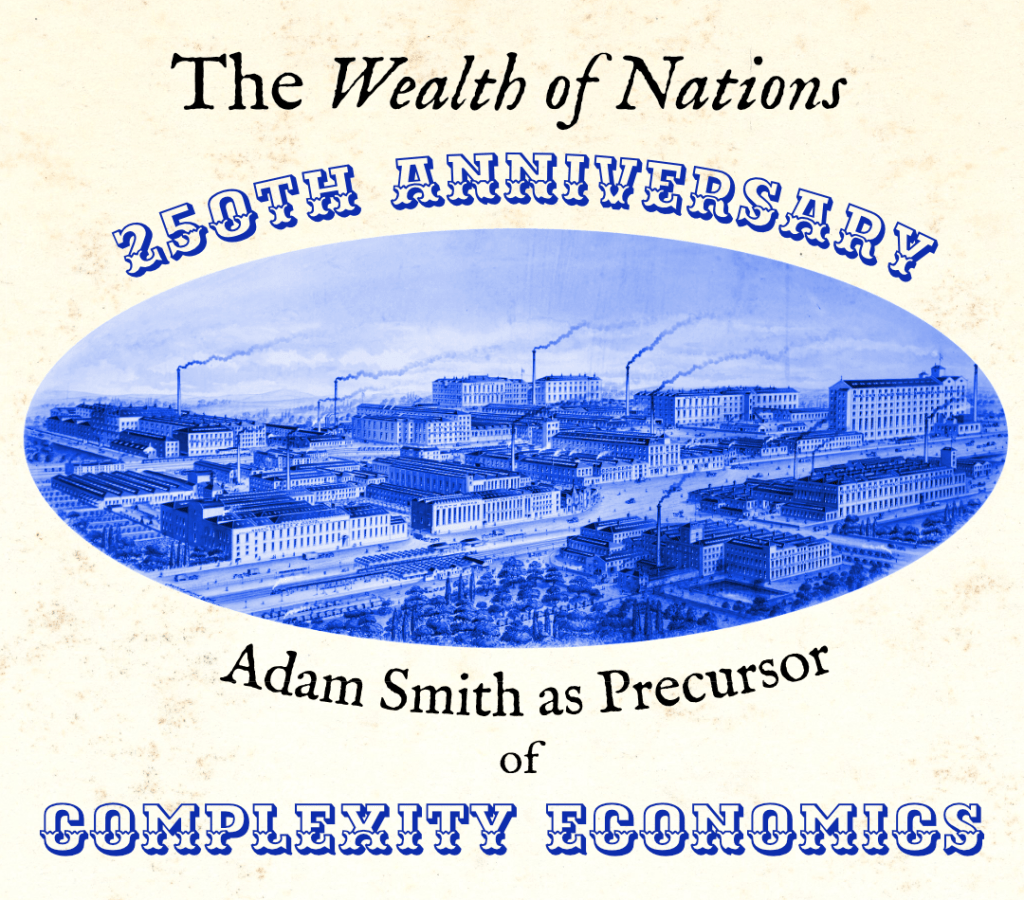
Smith spent 10 years writing The Wealth of Nations in Kirkcaldy. The image shows all the factories operated by Barry, Ostlere, and Shepherd in the town in 1905. The factories have been rearranged to appear as if they were all beside each other, but in reality, they are spread throughout the town. [Source]
 Filip Lubinski
Leave a comment