Competition Law, Complexity Economics,
and Computational Methods:
Systemic Approach
Abstract: A substantial number of recent studies on competition law related to complexity economics and computational methods form a new research program. It is a network of contributions sharing many features, linked by the same authors and institutions, influencing one another. From this network emerges a new idea, which we call here a Systemic Approach. Interest in complexity economics in research on competition law has been growing since the beginning of the 21st century. It has preceded an ongoing surge in research on the application of computational methods to investigations, enforcement, and policymaking. The literature in both areas occasionally mentions the connection between them but rarely discusses specific links. Sources discussing complexity economics often fail to explain the application of computational methods, and those presenting computational methods frequently overlook their theoretical foundation in complexity economics. Moreover, there is no single comprehensive literature review yet dedicated to any of these perspectives in competition law. Creating it is crucial because, as research in this area often concludes, the success of the emerging proposal for integrating complexity economics and computational methods into this field, the Systemic Approach, depends on making their insights accessible and interpretable. Here lies an essential obstacle. While sources in these areas attempt to explain abstract terms from domains of “complexity” or “computation,” they often do so in an unsystematic, isolated manner. Moreover, it is even more challenging to grasp the relations among the essential concepts of these two perspectives discussed in the literature. It creates a need for a comprehensive source that combines the two novel areas of research in competition law, while offering a dictionary of terms necessary to understand these links. The New Perspectives section of this paper considers essential concepts of complexity economics and computational methods in an order that makes their meanings more intuitive and the links between them more precise. It also illustrates them with examples familiar to competition law and economics researchers. The following section is a Literature Review of over 200 sources on competition law related to complexity economics and computational methods. It highlights the importance and impact of these studies, as well as the lack of essential explanatory links between the research conducted in them so far. The last section, Systemic Approach, provides a comprehensive review of recent achievements in complexity economics and computational methods in competition law investigations, enforcement, and policymaking. Some examples are activities undertaken by the European Commission and national competition authorities of the Member States. This paper might make an essential contribution to the evolution of research on competition law, from the acknowledgment of complexity economics to its operationalization with computational methods. To truly integrate into the economic paradigm of competition law, every new perspective on the economy needs both a sound theory, which will make it accessible, and reliable tools to make it applicable.
Keywords: Competition Law, Complexity Economics, Ecosystems, Computational Modeling, Legal Informatics, Agent-Based Models.
JEL Classification: A11, B41, B59, C63, K21, L40.
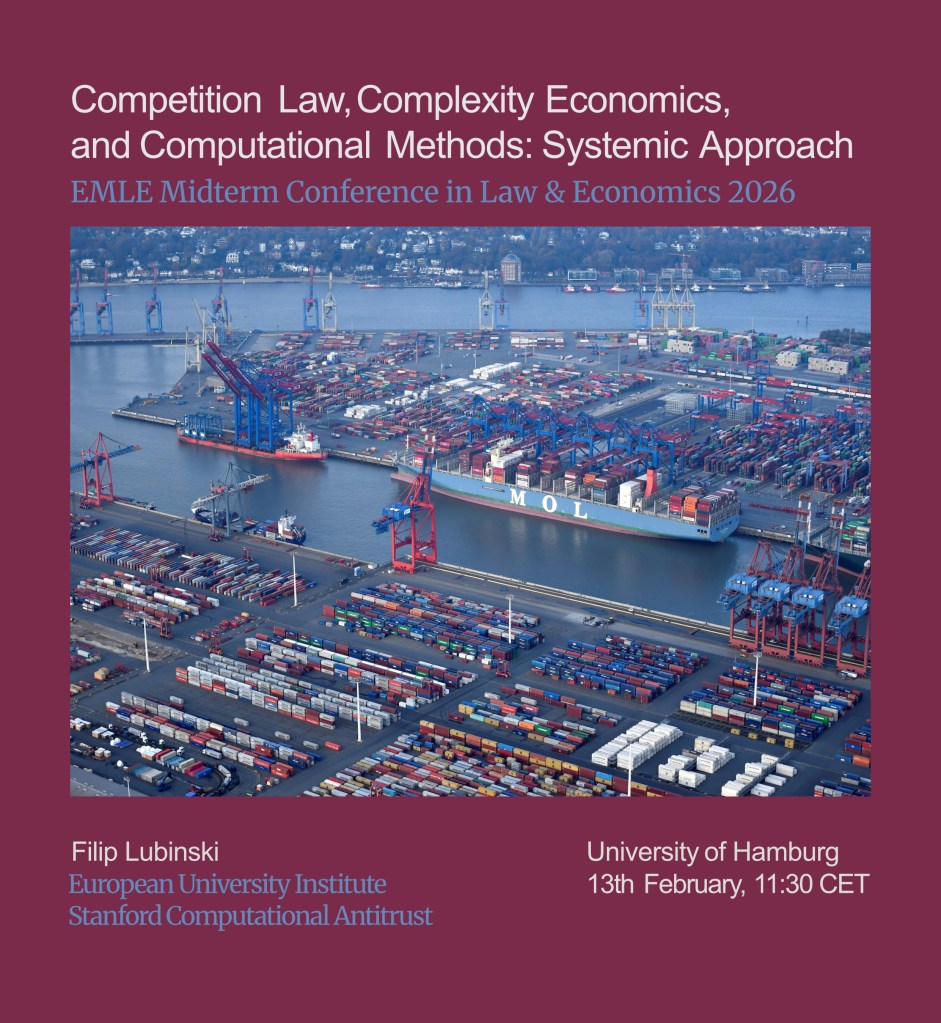
I’ll present the paper for the first time at the coming event:
 Filip Lubinski
Leave a comment